翻译

Search This Blog

Friday, August 12, 2016

UMD's H. Edward Reiley Garden - Azaleas & Rhododedrons

Summers in Maryland have always been hot, but my 2016 summer experience took the heat to a new level. This year, I interned on campus at the UMD Arboretum and Botanical Gardens with the hard workers of Facilities Management. I have gained a deeper appreciation and respect for the work that they do to keep our campus beautiful. Some tasks that I helped with included planting, clearing, watering, installing fences and weeding. Pulling weeds was the most performed task, but as my supervisor told me, "it is a necessary evil". It may be difficult at times, but it is satisfying to see the results of your labor.

Personally, the biggest difference I made this summer was on the H. Edward Reiley Rhododendron and Azalea Garden. It was the first space I was introduced to, and it was covered in weeds. The paths were impassable and the shrubs were taken over with vines such as poison ivy (Toxidendron radicans), which popped up beneath the benches.

Tall and short weeds cover the back of the Reiley Garden
This woodland garden is densely shaded, so even on a hot and humid day the space could provide some relief. Pulling weeds became meditative. After spending most of my summer in the garden, I feel attached to it and the work I have done. It was important not to feel overwhelmed by the task. With the help of an additional intern, and by taking the garden one section at a time, we were able to clear it in about a month!

First pile of many weeds this summer
A freshly cleared path

Repeatedly seeing and interacting with certain plants allowed me to learn about them and how to identify them. For example, blackberries, wineberries, and poison ivy all have similar leaves to the untrained eye. Subtle differences such as thorns, hairs, leaf margins, and size make identification easier.

Blackberry - Rubus fruticosus
Wineberry - Rubus phoenicolasius
Poison ivy - Toxidendron radicans
After we cleared the weeds it was time to give the garden a fresh look. One morning we were faced with a four foot pile of Leyland cypress (Cupressus x leylandii) wood chips. Winds lifted the fragrance of the wood through the garden as we spent the next few weeks dumping and spreading wheelbarrows of chips.

4' pile of Leyland cypress wood chips


I truly enjoyed working in this garden. Returning it to an enjoyable and usable space makes me appreciate the privileges I have on this campus. I will certainly return to the garden during the school year. 

~

The H. Edward Reiley Rhododendron and Azalea Garden is located next to the Arboretum Outreach Center (156) on Stadium Drive. Directions


Autumn Dorsey, Student Intern 2016
University of Maryland

Wednesday, December 2, 2015

Where have all the insects gone?


Have you noticed lately that there are fewer insects scampering or buzzing around the University of Maryland campus?  Do you wonder where they go when the temperatures outside begin to dip? Well, in the fascinating world of insects, they have mastered numerous methods in which to survive the cold freezing temperatures in order to thrive and return when the weather warms up.   Insects will overwinter for the most part in a stage of growth best adapted to the cold temperatures; that is, adult, larva, nymph, pupa, egg or even migrate to warmer climates.

Adult BMSB
 photo UMD Entomology
The Brown Marmorated Stink Bug (BMSB), Halyomorpha halys, Order: Pentatomidae overwinter as adults.  You know, those stinky pests everyone has been talking about lately.  They like to hunker down through the winter months like a hibernating bear in people's homes. To find out more about this insect go to Stink Bug

japanese beetle life cycle
An insect that will overwinter in the larval stage is the Japanese beetle, Popillia japonica, Order: Coleoptera. The larval stage is the immature, wingless stage of an insect that does not look anything like the adult stage.  The grub like larva will burrow deep into the soil where it is warmer.  Go to The Japanese beetle to discover more about this insect.


Adult Mayfly
 photo Nancy Harding, UMD
Some species of mayflies; Order Ephemeroptera, will overwinter as nymphs; that is, the youth of an insect that resembles the adult more and more as it grows.  There are not many insects that are active in the winter, but some mayflies will live in waters of ponds and streams, often beneath ice and feed actively all winter long to emerge in the early spring.  Learn more about mayflies go to Mayfly fact sheet.


There are other insects that overwinter in the pupal stage; that is, the non-feeding, transitional stage of an insect that will emerge from its shelter in the spring as an adult.  The house-fly, Musca domestica, Order: Diptera, is just one those insects and can overwinter under manure piles or other protective areas.  Fly pupa is similar to a butterfly cocoon, it is a hard, brown shell which protects the developing fly.  Learn more about Flies.


Wheel bug egg mass
photo UMD-IPMnet

Wheel bug adult
 photo UMD Entomology
Fewer insects overwinter in the egg stage; however one such insect is the wheel bug (assassin bug) Arilus cristatus, Order: Hemiptera.  The wheel bug eggs are laid in tight, upright clusters normally found on bark. See more about the Assassin bug.


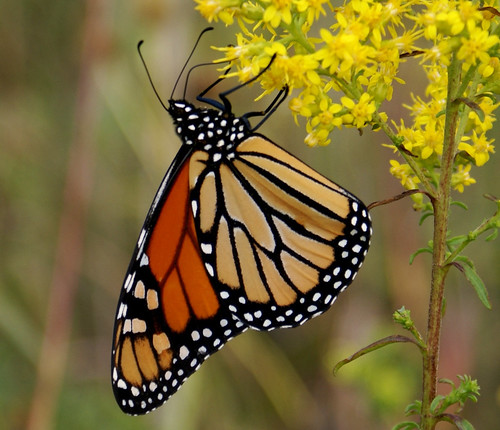
A butterfly on a flower
NCRS photo Gene Barickman
In  my opinion, and I think others share my opinion, the most amazing insect is the Monarch butterfly; Danaus plexippus, Order: Lepidoptera. According to the United States Department of Agriculture website 'the annual migration of North America's monarch butterfly is a unique and amazing phenomenon.  The monarch is the only butterfly known to make a two-way migration as birds do.  Unlike other butterflies that can overwinter as larvae, pupae, or even as adults in some species, monarchs cannot survive the cold winters of northern climates.  Using environmental cues, the monarchs know when it is time to travel south for the winter.  Monarchs use a combination of air currents and thermals to travel long distances.  Some fly as far as 3,000 miles to reach their winter home'.  Watch this video regarding the amazing Monarch Butterfly migration


Contact Information for the University of Maryland Arboretum and Botanical Garden

Mailing and Shipping address (This is the location of our partner, UMD Landscape Services, and the office of our Assistant Director, Karen Petroff):
University of Maryland
Wye Oak Building (428)
4201 Landscape Ln.
College Park, MD 20742-7215
phone: 301-405-3320
fax: 301-314-9943
hours: 6 am to 2:30 pm, M-F

Horticulturist's Offices and Meeting Room (No mail delivery or shipping to this location):
University of Maryland
Arboretum Outreach Center (156)
3931 Stadium Dr.
College Park, MD 20742
phone: 301-405-3320
fax: 301-314-9943
hours: 7 am to 3:30 pm, M-F, by appointment or prescheduled times only, as sometimes everyone is out on campus and the building will be locked

When using the UMD Campus Map, you can click on a building name and the street address of that building and other information about that building should come up in a pop up window.

blog administrator, Sam Bahr, 301-405-7926 or 301-405-3320
e-mail: sbahr@umd.edu

updated 1/30/20

Parking

Our gardens are free and open to the public. There are some parking lots (read the signs for that parking lot carefully) that are free to park in after 4 pm and before 7 am and on weekends, except on game days and during other special events. There is public parking in four large parking garages at the rate of $3 per hour with a daily maximum of $15. On weekends in the garages, the rate is $3 per hour with a daily maximum rate of $5 per hour. There is a small amount of additional pay parking along some streets.

Navigation around campus is much easier with this interactive campus map. You can look up parking locations and building locations using this map. Use the search tab to bring up the page to search for campus building names, locations and addresses. If you click on a building name on this interactive campus map, a popup window should appear with the address and other details about the building.

updated 10/6/2015


Butterfly feeding on the nectar of Russian Sage blossoms

General Information about the UMD Arboretum and Botanical Garden

The University of Maryland, the state’s flagship campus, is located in the Baltimore-Washington corridor. The American Association of Public Gardens, by designating the university as an arboretum and botanical garden in 2008, recognized former President C.D. Mote, Jr.’s commitment to becoming a green campus. Maryland is also the first university in the state to be honored as a Tree Campus USA by the Arbor Day Foundation.

The Arboretum and Botanical Garden consists of our entire 1,250 acre College Park, Maryland campus. The Campus collection of over 8,000 trees, garden plantings and nearly 400 acres of undeveloped urban forest is a beautiful reminder of Maryland’s history and a harbinger of Maryland’s future. The university looks at the campus’ green space as a major resource for its educational, research and service missions.

Hornbake Plaza

Hornbake Plaza
Honeylocust fall foliage color

University of Maryland Arboretum Explorer or UMD ABG Explorer (Tree and Shrub Inventory)
You can look up the identity of many trees and shrubs using this interactive campus map: https://maps.umd.edu/abg/. Herbaceous plants and even some small woody plants are not a part of this inventory. It is still a work in progress and we do not consider it a complete or entirely up to date inventory.

Our plant inventory or plant collections database can also be considered a plant database, plant search, plant locator, plant finder, plant collection database, living collections management system, plant records system or plant mapping system for campus plantings.

updated 1/30/20

Image and Link to the Interactive Campus Map Showing the Campus Plant Inventory

Tawes Plaza Gardens

Tawes Plaza Gardens
Kim's Knee High Purple Coneflower, Russian Sage, White Out Rose and Dwarf Pampas Grass are featured in this planting in 2010.